
The WiFi on the AeroGarden Bounty Elite is bad. I don’t mean “occasionally finicky” or “takes some patience to set up.” I mean it drops connection constantly, only works on 2.4GHz networks, and the app it connects to adds almost nothing you can’t already see on the physical display sitting right there on your counter. And yet the WiFi is the feature AeroGarden markets hardest when justifying the price jump from Basic to Elite. That’s the wrong reason to spend more money.
The right reason is light wattage. But I’ll get to that.
Quick Answer: For herbs, lettuce, and greens, get the Bounty Basic. It’s 30W, it does the job, and it drops to around $90 on sale. The Elite’s 50W light panel matters if you’re growing peppers, tomatoes, or anything that fruits, but the WiFi/Alexa features are broken and have been for years. Don’t pay extra for connectivity. Pay extra for light, if you need it.
| Product | Price | Rating | Key Feature | |
|---|---|---|---|---|
 AeroGarden Bounty Elite Indoor AeroGarden Bounty Elite Indoor | 4.1★ (4) | THE NEW TOP OF THE LINE BOUNTY ELITE - Perfect for a variety of BIG harvests (he | Check Price | |
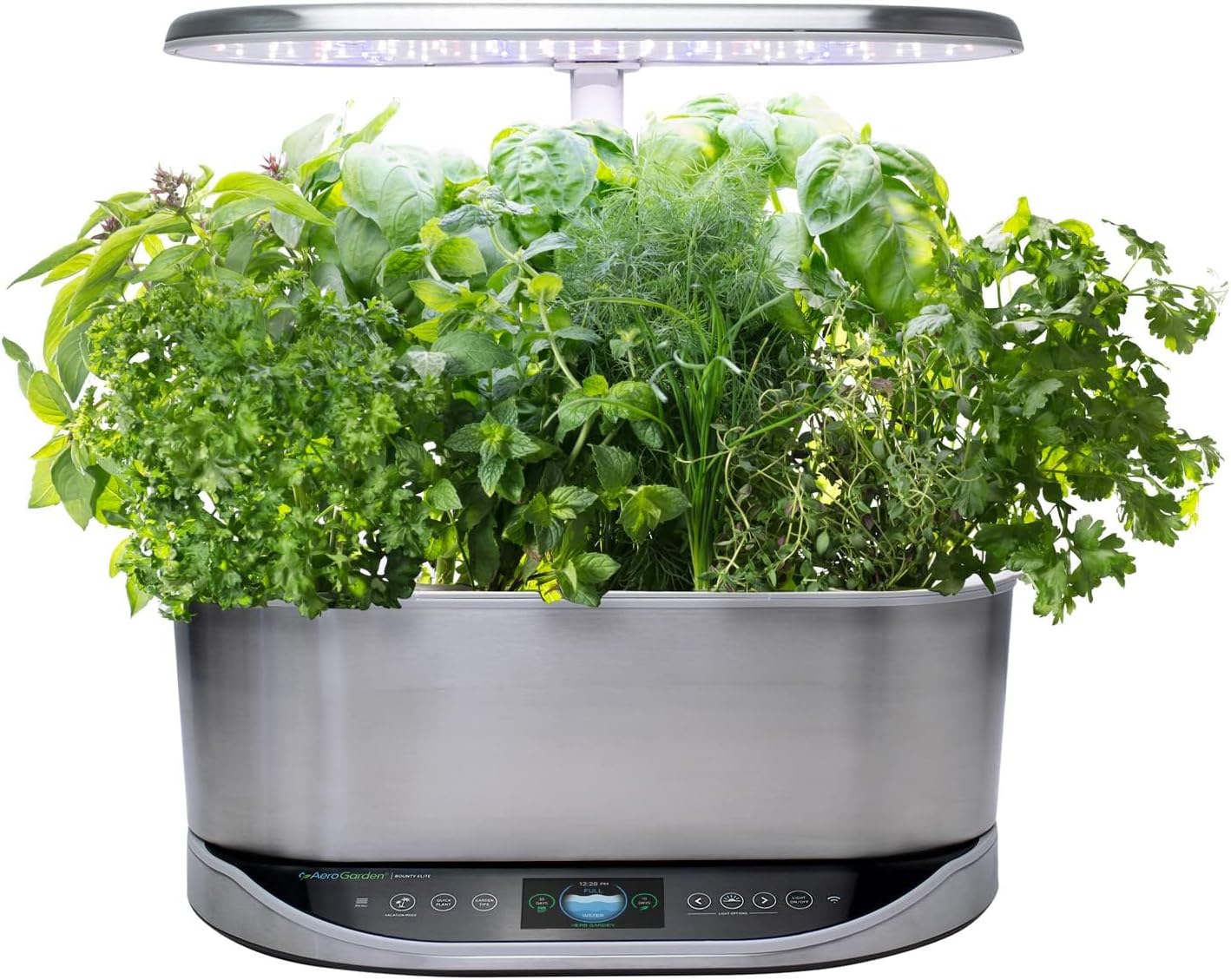 AeroGarden Bounty Elite - Indoor Garden AeroGarden Bounty Elite - Indoor Garden | 4.5★ (1,862) | Use this indoor garden to grow up to 9 different herbs, veggies, or flower varie | Check Price | |
 AeroGarden Bounty Basic - Indoor Garden AeroGarden Bounty Basic - Indoor Garden | ~$179.95 | 4.5★ (4,902) | Automatic timer makes sure the lights go on and off at exactly the right time, a | Check Price |
AeroGarden Is Back, By the Way
Quick context for anyone who missed this: AeroGarden went through a rough patch. The brand basically disappeared for a while, stock dried up, and a bunch of us were stuck hunting for pods on eBay. They relaunched in early 2025 with refreshed models and new packaging. The Bounty lineup survived the transition more or less intact, which means the Basic and Elite are both currently available and in stock. I covered some of the fallout in my piece on AeroGarden vs iDOO vs Click and Grow , but the short version is: AeroGarden is alive, and these units are still worth talking about.
The Three Things That Actually Differ
A lot of comparison articles list out every feature side by side in a table and call it a day, which is fine if you already know what matters. Most people don’t. So here’s what’s actually different between the Bounty Basic and the Bounty Elite, stripped of marketing language.
Light wattage. The Bounty Basic buy on Amazon runs a 30W LED panel. The Bounty Elite check current price runs 50W. There’s also a middle-tier Bounty (not Basic, not Elite) that sits at 40W, but it’s harder to find and I think AeroGarden has been quietly phasing it out. The wattage difference is real and it matters for certain crops. More on that below.
WiFi and Alexa. The Elite connects to WiFi and can be controlled through the AeroGarden app or an Alexa device. The Basic has no WiFi. It has a digital display, an automatic light timer, water reminders, plant food reminders, and vacation mode. Everything you need to actually grow plants is on the Basic’s screen. The WiFi on the Elite is supposed to let you monitor and adjust things remotely, get push notifications, that kind of thing.
Finish and price. The Elite comes in stainless steel. The Basic is black plastic. Both have the same 9-pod capacity and the same 24-inch grow height. At full retail, the Basic lists around $180 and the Elite can run $200-plus, but nobody should be paying full price for either of these. The Basic drops to around $90 on sale pretty regularly. The Elite hits $130 to $160 during sales. That price gap matters because it changes the calculus of whether the extra wattage is worth it.
Why the WiFi Is a Waste
I’m not being dramatic here. The r/aerogarden community on Reddit has been complaining about the WiFi for years, and multiple threads confirm the same pattern: the garden connects to your network, works for a few days, then silently disconnects and never reconnects without a full reset. One thread I remember reading had someone say “don’t buy the Elite for WiFi, it’s a waste of money,” and dozens of people agreed in the comments. AeroGarden apparently acknowledged the problem at some point and just… never fixed it.
The app itself is thin. You can see light status, water level, and set reminders. All of which the physical touchscreen already does. Standing in your kitchen. Where the garden is. I’ve never once been away from my apartment and thought, “I really need to check my herb garden’s water level right now from my phone.” If you’re gone long enough that remote monitoring matters, vacation mode handles it. And vacation mode works on the Basic too.
The Alexa integration is even more pointless. “Alexa, turn on my garden lights.” They’re already on a timer. They turn on by themselves. I cannot figure out who this feature is for.
So when I say skip the WiFi, I mean it. The connectivity features on the Elite are the worst reason to spend more.
When the Extra Wattage Matters (And When It Doesn’t)
This is the real decision. Not WiFi. Not stainless steel. Light.
30W is plenty for basil, cilantro, parsley, dill, mint, lettuce, and most leafy greens. I’ve grown all of these on 30W setups and never felt like the plants were starving for light. Basil in particular just explodes under any AeroGarden, and I’ve had to prune mine back aggressively by week four regardless of which model I was using. I wrote about growing lettuce in an AeroGarden and the light was never the issue there, it was tip burn from heat and airflow.
Where 50W starts to matter is fruiting plants. Tomatoes, peppers, strawberries, anything that needs to flower and then set fruit. These plants are hungrier for light, and the difference between 30W and 50W can show up as fewer flowers, smaller fruit, or a longer time to harvest. I’ve seen a couple YouTube grow experiments comparing Basic and Elite side by side for tomatoes and cucumbers, and the Elite consistently produced more. Not double the yield or anything wild, but noticeably more fruit.
My own experience lines up with this. I grew cherry tomatoes on a Bounty and the yield was decent but I felt like the plants were reaching and stretching more than they should have been, which is usually a sign they want more light intensity than they’re getting. I talked about that a bit in my post on growing cherry tomatoes indoors . If I were doing tomatoes again, I’d want the 50W panel. For basil and lettuce? I’d feel silly paying for it.
A Tangent About Grow Light Math
This is something I find kind of interesting even though it doesn’t directly help you pick between these two models. Wattage isn’t the whole story with grow lights. Two 30W LEDs from different manufacturers can produce wildly different amounts of usable light for plants because the spectrum matters, the efficiency of the diodes matters, and how tightly the light is focused onto the grow area matters. AeroGarden doesn’t publish PAR (photosynthetically active radiation) numbers for the Bounty line, which is annoying because wattage alone tells you how much electricity the light draws, not how much of that energy is turning into photons your plants can actually use.
I’ve seen people on Reddit stick a PAR meter under their Bounty and report numbers, but the readings vary enough that I’m not sure anyone’s doing it consistently, and honestly I think the sample sizes are too small to mean much. What I do know from growing on these units is that the jump from 30W to 50W produces a visible, obvious difference in light intensity. You can see it with your eyes when you hold your hand over the pods. And the heat difference is noticeable too, the Elite’s panel runs warmer, which is something to think about if you’re growing lettuce that’s already prone to tip burn.
I should write about PAR readings for countertop gardens at some point, actually. I’ve been meaning to borrow a meter from a friend who does reef tanks. But that’s a different article.
What About the “Grow Anything” Kit?
The newer Bounty Elite listing see on Amazon comes bundled with a Grow Anything seed pod kit, which includes the pod baskets, sponges, domes, liquid plant food, and labels, but no seeds. You bring your own seeds. This is actually a nice inclusion if you want to grow something outside AeroGarden’s pre-seeded pod lineup, because those proprietary pods add up fast and the selection isn’t always what you want.
One thing I noticed in the reviews for that particular listing: someone reported only 3 out of 9 seed pods produced anything, which is rough. AeroGarden claims 100% germination on their pre-seeded pods, but that guarantee doesn’t apply when you’re using the Grow Anything kit with your own seeds. Germination rates with your own seeds depend entirely on seed quality, how deep you plant them, and whether you keep the domes on long enough. It’s not really a product flaw, it’s just a different experience than dropping in a pre-seeded pod and watching it go.
I’d still recommend the Grow Anything kit for anyone who’s been doing this for a while, because buying replacement pod kits from AeroGarden at $15-20 for a six-pack is, frankly, a ripoff. Generic sponges and baskets work fine. I covered cheaper AeroGarden nutrient alternatives in another post, and the same cost-saving mindset applies to pods.
Buy the Basic If / Buy the Elite If
Get the Basic if:
- You’re growing herbs, lettuce, salad greens, or flowers
- You don’t care about WiFi (you shouldn’t)
- You want the best value, especially at the ~$90 sale price
- This is your first AeroGarden and you’re not sure you’ll stick with the hobby
- Your counter space is limited and you just want something that works without overthinking it
Get the Elite if:
- You’re growing tomatoes, peppers, strawberries, or other fruiting plants that need strong light
- You want the stainless steel look (my partner actually prefers how this one looks, which is the one time aesthetics have won an argument about my gardening equipment)
- You can find it on sale for $130-ish and the $40 premium over the Basic feels reasonable to you for 20 extra watts
Don’t get the Elite if your primary reason is WiFi, Alexa, or the app. You’ll be disappointed. The connectivity barely works, and even when it does, it doesn’t add anything the physical display doesn’t already handle.
I keep coming back to the Basic as my recommendation for most people, and honestly for most of what I grow, which is 80% herbs and greens. The times I’ve wanted more light, I’ve considered just supplementing with a separate grow light rather than buying a whole different unit, and I went into that topic in my post about grow lights for countertop herb gardens .
One More Thing About Sale Prices
Neither of these units is worth buying at full MSRP. The Bounty Basic’s list price is around $180, which is absurd for what you get. At $90 on sale, it’s a good deal. The Elite at $130-160 is reasonable. At $200+, you’re paying a premium for WiFi that doesn’t work and a stainless steel shell. Amazon runs sales on these frequently enough that you should never feel rushed. Set a price alert and wait. I think I’ve seen the Basic hit $85 during Prime Day, maybe even lower, though I’m not totally sure on the exact number.
You’re going to be tempted by the Elite’s marketing copy, which makes it sound like a smart garden with connected features and app control and all that. Ignore the copy. It’s a grow light on a water basin with a nice screen. Both models are that. The only question is how much light you need.
This article is part of my The Complete AeroGarden Guide , a complete resource for countertop hydroponic growing.
Frequently Asked Questions
Is the AeroGarden Bounty Elite worth the extra money over the Basic?
Only if you’re growing fruiting plants like tomatoes or peppers that benefit from the 50W light panel. For herbs and greens, the Basic’s 30W is more than enough. The WiFi and Alexa features on the Elite are unreliable and shouldn’t factor into your decision. At sale prices, the gap is about $40-60, so it depends on what you’re growing.
Does the WiFi on the AeroGarden Bounty Elite actually work?
Barely. It connects over 2.4GHz only, drops randomly, and requires frequent resets. The AeroGarden community on Reddit has documented this problem for years. The app itself doesn’t offer much you can’t already see on the touchscreen. I wouldn’t pay a premium for this feature.
Can I grow tomatoes in the AeroGarden Bounty Basic?
You can, but you might see lower yields and more stretching compared to the Elite. The 30W panel is designed more for herbs and greens. If tomatoes and peppers are your main goal, the Elite’s 50W light gives them more of what they need to flower and fruit. I’ve grown cherry tomatoes on a Bounty and they produced, but I felt like the plants wanted more light than they were getting.
How often do the AeroGarden Bounty models go on sale?
Pretty often. Amazon discounts both models during Prime Day, Black Friday, and random sales throughout the year. The Basic regularly drops to around $90. The Elite hits $130-160. I’d set a price tracker alert and avoid paying full list price, because the markdowns happen frequently enough that waiting a few weeks usually saves you $50 or more.
What’s the difference between the AeroGarden Bounty and the Bounty Basic?
The mid-tier Bounty (not Basic, not Elite) has a 40W light panel and WiFi, sitting between the two. It’s been harder to find since the AeroGarden relaunch and I think it’s being phased out. If you can find it on sale, it’s a decent middle ground, but the Basic and Elite are the two models most people should be choosing between.
Fair warning: affiliate links ahead. I earn a small commission on purchases, which helps keep this site running. You pay the same either way.