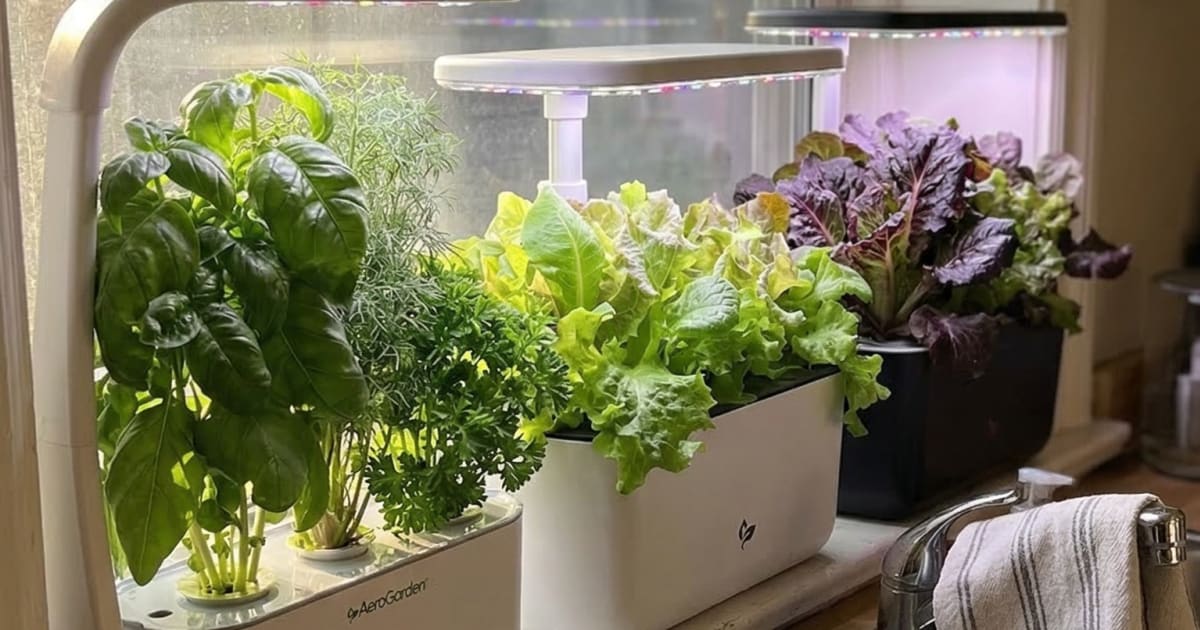
The question that keeps coming up, on Reddit and in my inbox, is some version of: which one should I actually start with?
And I get it. The AeroGarden Sprout buy on Amazon and the Harvest line look like the same product in different sizes, and the price gap isn’t always that dramatic depending on when you’re shopping. So I ran them side by side for eight weeks last fall, same herb kit, same windowless corner of my kitchen shelf, same tap water, to figure out where the real differences land.
Quick Answer: Get the Harvest Lite, not the Sprout. The Harvest gives you 6 pods, a 20W light, and an actual pump for less money than the Sprout’s 3 pods and 10W wick system at full price. The Sprout is only worth it below $40 on sale or as a gift for someone who might not stick with the hobby.
 AeroGarden Sprout - Indoor Garden with LED Grow Light, White
Compact 3-pod hydroponic system with 10W LED grow light, grows herbs and greens up to 10 inches tall with automatic wate
~$79
AeroGarden Sprout - Indoor Garden with LED Grow Light, White
Compact 3-pod hydroponic system with 10W LED grow light, grows herbs and greens up to 10 inches tall with automatic wate
~$79
 AeroGarden Harvest Lite in Cream, Soil-Free Indoor Hydroponic Garden with LED Grow Light for Year-Round Gardening of up to 6 Herbs and Vegetables
6-pod hydroponic system with LED grow light, ideal for growing herbs and vegetables indoors year-round without soil
~$65.71
AeroGarden Harvest Lite in Cream, Soil-Free Indoor Hydroponic Garden with LED Grow Light for Year-Round Gardening of up to 6 Herbs and Vegetables
6-pod hydroponic system with LED grow light, ideal for growing herbs and vegetables indoors year-round without soil
~$65.71
 AeroGarden Harvest Slim Indoor Garden Hydroponic System with LED Grow Light and Herb Kit, Holds Up to 6 Pods, Black
6-pod hydroponic system with 20W LED grow light, ideal for growing herbs and small plants indoors year-round
AeroGarden Harvest Slim Indoor Garden Hydroponic System with LED Grow Light and Herb Kit, Holds Up to 6 Pods, Black
6-pod hydroponic system with 20W LED grow light, ideal for growing herbs and small plants indoors year-round
 AeroGarden Harvest 2.0, Indoor Garden Hydroponic System with LED Grow Light, Holds up to 6 Pods, Charcoal
6-pod hydroponic system with 15W LED light, grows herbs and vegetables up to 12 inches tall indoors year-round
~$69.29
AeroGarden Harvest 2.0, Indoor Garden Hydroponic System with LED Grow Light, Holds up to 6 Pods, Charcoal
6-pod hydroponic system with 15W LED light, grows herbs and vegetables up to 12 inches tall indoors year-round
~$69.29
Here’s what I found.
The first two weeks look identical
Both units shipped with a three or six pod herb kit respectively, both germinated basil, parsley, and mint within about five days. The Sprout’s three pods were popping at roughly the same rate as the Harvest’s six. No difference in germination speed that I could see, and the light cycle setup on both is basically the same soft-touch button experience. At week two, I couldn’t tell you which counter I’d rather have.
That changed.
By week four, the basil in the Harvest was visibly bushier. The Sprout basil was growing but staying tighter, and I think it was hitting the 10W light limit before it hit any other constraint. The Harvest runs a 20W LED, and on herbs that want to spread out, basil especially, you can feel that extra wattage in the canopy. The Sprout tops out plant height at 10 inches, and my basil was pressing against the lamp by week five—something I address directly in how I set my hydroponic garden lights . I trimmed it back and it was fine, but it’s a real ceiling.
The other thing that Reddit gets right: the Sprout’s water system is a wick, not a pump. AeroGarden’s listing now says “silent pump” but what that actually means in practice is passive wicking rather than active circulation. For three pods of herbs, it works. But it’s not the same as a real pump pushing water through six pods, and I’d be lying if I said the root system on the Sprout basil looked as healthy at week six. Roots were shorter and less developed compared to what I was seeing in the Harvest.
Week eight, the Harvest had given me four solid basil harvests. The Sprout had given me two, maybe two and a half if I’m being generous.
So what’s the Sprout actually for?
Gifts and first-timers. That’s my honest answer.
Around the holidays, the Sprout frequently bundles down to around $25 with a seed kit included, and at that price it’s hard to argue against. It’s a real hydroponic unit, it grows real plants, and for someone who’s never tried this before, three pods is less overwhelming than six. You’re not committing to a full herb garden. You’re dipping a toe in.
I gave one to my neighbor’s teenager last winter. She grew basil and some peppers (the peppers were a mistake, they got too tall, but she learned something) . The Sprout handled it fine for a beginner.
But if you’re already interested enough to be reading a comparison article? You want the Harvest.
AeroGarden Sprout - Indoor Garden with LED Grow Light, White
Compact 3-pod hydroponic system with 10W LED grow light, grows herbs and greens up to 10 inches tall with automatic wate
Check Price on AmazonThe Harvest line is where things split
This is where I need to explain what you’re actually choosing between, because “Harvest” now covers a few different units.
The AeroGarden Harvest Lite see on Amazon is the stripped-down version, six pods, 20W light, but no app, no Wi-Fi, just a simple indicator light that tells you when to add water or food. It comes in a cream finish that’s actually pretty nice on a kitchen counter. My partner, who complains about basically everything I add to the shelf, said it didn’t look bad, which for him is high praise. The Harvest Lite runs cheaper than the standard Harvest 2.0 and for most people growing herbs, the lack of app control is not a problem. I don’t need my basil to send me push notifications.
The AeroGarden Harvest 2.0 check current price adds Wi-Fi, app connectivity, and a few smart reminders. If you want to set custom light schedules or get reminders on your phone when it’s time to add nutrients, that’s what you’re paying for. Honestly, I’ve used the app feature maybe five times. The light timer works fine without it. But if you travel a lot and want to check in remotely, it’s not a useless feature.
Then there’s the AeroGarden Harvest Slim check price on Amazon , which is the one I’d pick if counter depth is your actual problem. It holds six pods like the standard Harvest but in a narrower footprint, which matters more than you’d think when you’re working with a dedicated 12-inch shelf the way I am. It’s not dramatically smaller from the front, but from the side it tucks in better. The trade-off is it only comes in black, which may or may not bother you.
Specs side by side
| Sprout | Harvest Lite | Harvest 2.0 | Harvest Slim | |
|---|---|---|---|---|
| Pods | 3 | 6 | 6 | 6 |
| LED wattage | 10W | 20W | 20W | 20W |
| Max plant height | 10" | 12" | 12" | 12" |
| Water system | Wick | Pump | Pump | Pump |
| App/Wi-Fi | No | No | Yes | No |
| Approx. price | ~$79 (often less) | ~$69 | Varies | Check current |
A couple of things in that table are worth sitting with. First: the Harvest Lite is actually cheaper than the Sprout at full price, which makes the Sprout hard to recommend unless it’s on sale. Second: all three Harvest variants give you six pods and 12 inches of clearance, so the main decision within that tier is app features vs. counter footprint vs. color.
The light glow situation
My partner’s one real complaint about all of these is the grow light at night. The Harvest’s 20W is noticeably brighter in a dark room than the Sprout’s 10W, both units default to a 16-hours-on, 8-hours-off cycle, and if that overlaps with sleeping hours, you’ll know it. I run mine on a delayed start so the lights go off around 10pm. Both units let you customize this; the Harvest 2.0 does it through the app, the others you set by holding the button at a specific time of day. It’s a little clunky either way but you figure it out.
I did try one grow of lettuce in the Harvest last spring. Lettuce in AeroGardens is its own thing, if you’re doing that, read how to grow lettuce in an AeroGarden without tip burn before you start, because I made every mistake described in that post before I read it.
My actual recommendation
Get the Harvest Lite if you’re buying for yourself and you want to actually cook with what you grow . It’s the least expensive six-pod option, the cream finish is nice, and dropping the app features costs you nothing meaningful in real-world growing performance. If counter depth is tight, get the Harvest Slim instead.
Get the Sprout only if it’s bundled below $40, or if you’re buying it as an introductory gift for someone who might not stick with the hobby. At $79 full price, the Harvest Lite beats it on basically every spec.
The Harvest 2.0 with app control is worth it if you travel or really want phone reminders. I don’t need that, but I know people who use it.
What I’d skip entirely: buying the Sprout at regular price when the Harvest Lite exists. That’s the comparison nobody seems to mention in these posts, and it’s the one that should actually drive your decision. If you’re also looking at the Bounty as a step up, I break that down in my Bounty vs Harvest comparison .
🌱 Best for Beginners
AeroGarden Harvest Lite in Cream, Soil-Free Indoor Hydroponic Garden with LED Grow Light for Year-Round Gardening of up to 6 Herbs and Vegetables
6-pod hydroponic system with LED grow light, ideal for growing herbs and vegetables indoors year-round without soil
Check Price on AmazonFrequently Asked Questions
Is the AeroGarden Sprout worth it?
At $25-40 during a sale or bundle, yes, it’s worth it as a starter unit or gift. At $79 full price, the Harvest Lite gives you twice the pods, more light, and an actual pump for less money. The Sprout’s niche is value pricing, not performance.
What’s the difference between the Sprout and Harvest?
Pods (3 vs. 6), light wattage (10W vs. 20W), plant height limit (10" vs. 12"), and water system (wick vs. pump). The Harvest grows more, grows bigger, and circulates water more actively. For casual herb growing those differences don’t show up immediately, but by week four or five they’re hard to miss.
Can I use Harvest seed pods in the Sprout?
Yes, AeroGarden pods are cross-compatible across their lineup. The Sprout takes the same pods as the Harvest and Bounty. The only difference is how many slots you have and how much room the plants get to grow.
Does the Sprout’s wick system affect plant health?
For short-term herb grows, the wick works fine. Over longer grows, I noticed roots in the Sprout were shorter and less developed compared to the pump-fed Harvest. If you’re planning to run a grow beyond six or eight weeks, the pump makes a real difference in root health and water circulation.
This article is part of my The Complete AeroGarden Guide , a complete resource for countertop hydroponic growing.