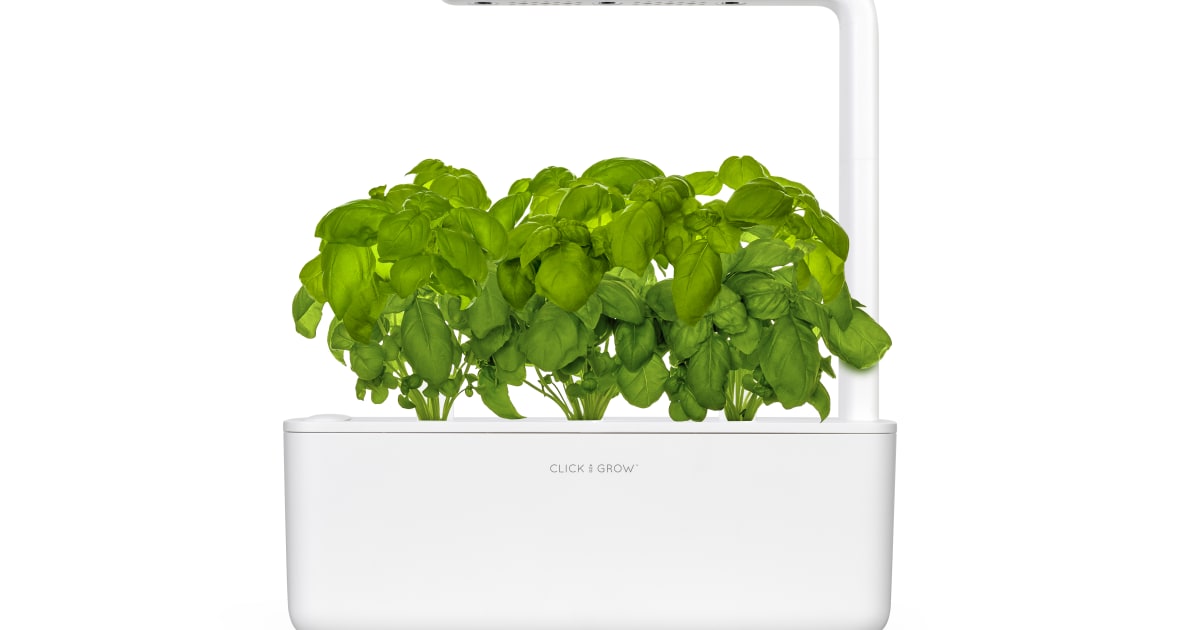
The Click & Grow Smart Garden 3 is probably the nicest-looking indoor garden I’ve put on my kitchen counter. My partner said it was the only one that didn’t make our apartment look like a grow house. I still returned it.
Not because it was bad. The basil sprouted in four days, the light was gentle enough to leave on overnight without it lighting up the whole room, and I never once had to measure nutrients or check pH. For someone like me who spends half her time adjusting water levels on an AeroGarden, that part felt like a vacation.
But then the pods ran out.
Quick Answer: The Click & Grow Smart Garden is a soil-based indoor planter with a grow light, not a hydroponic system. It’s the easiest indoor garden you can buy. Zero nutrient mixing, no pump, no water level anxiety. The catch is pod costs: roughly $3-5 each with no good DIY alternative. If you want one, get the Smart Garden 9 at $249.95 . Skip the 3-pod (too small for the price) and the 9 PRO (Bluetooth isn’t worth $50 extra). Use code SPROUTFLAT for 10% off at clickandgrow.com.
| Model | Pods | Price | Rating | |
|---|---|---|---|---|
 Smart Garden 3 Smart Garden 3 | 3 | $124.95 | 4.6★ (2,354) | Check Price |
 Smart Garden 9 Smart Garden 9 | 9 | $249.95 | 4.4★ (1,200+) | Check Price |
| Smart Garden 9 PRO | 9 | $299.95 | 3.7★ (30) | Check Price |
What Click & Grow Gets Right
I want to be fair about this because there’s a real audience for this product and it’s not the audience I usually write for on this site.
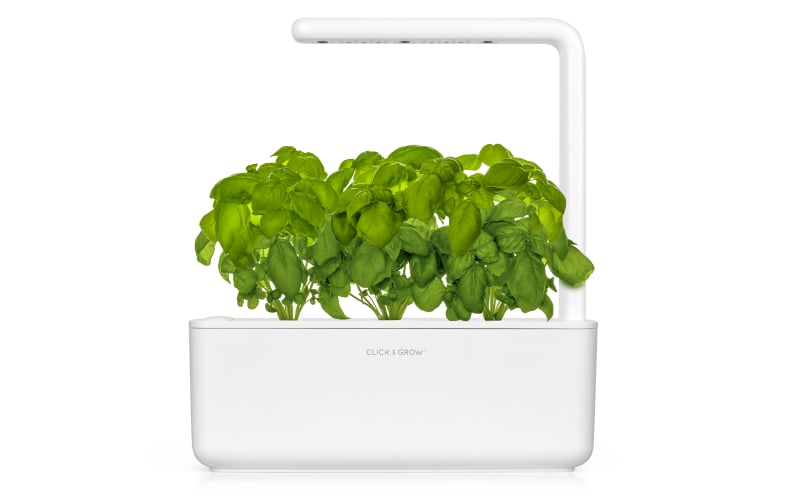
Click & Grow uses what they call “Smart Soil,” a peat-based growing medium with slow-release nutrients already baked in. You drop a pod in, fill the water tank, and the plant grows like a potted herb would, just with better lighting and a self-watering system underneath. There’s no pump, no nutrient schedule, no water level sensor beeping at you. The reservoir on the Smart Garden 3 lasted me close to three weeks before it needed a top-off.
That matters more than most reviews give it credit for. I know people who tried an AeroGarden, forgot to add nutrients for a month, watched everything yellow and die, and gave up on indoor gardening forever. The Click & Grow wouldn’t have let that happen. It’s nearly impossible to kill basil in one of these things unless you forget water exists.
The units also run on about 8 watts. My AeroGarden Harvest draws 20W and the Bounty pulls 30W. Click & Grow says their gardens use four times less energy than competitors, and from what I’ve measured that tracks. Not a huge deal on the electric bill, but it’s a real number and they’re not making it up.
And they’re quiet. Dead silent. No pump hum at 2am.
The Smart Garden 3 ($124.95): Too Small for the Price
This is the model I tested. Three pods. Three basil plants. That’s what you get for $125.
It worked fine. The basil sprouted fast, the light was pleasant, setup took maybe 90 seconds. My partner liked the look of it. I liked not having to think about it. For about six weeks I had fresh basil growing on my counter with zero effort and I used it on pizza and pasta and that was nice.
Then the pods ran out and I went to order replacements. A 3-pack of basil pods costs about $10-15 depending on the variety. That’s $3-5 per pod for something that lasts two to three months. Not devastating, but compared to buying a $3 packet of basil seeds that gives me dozens of grows in my AeroGarden, it felt like a tax on convenience.
I returned the Smart Garden 3 within the Amazon return window. The math bothered me.
 Click & Grow Smart Garden 3
Shop on Click & Grow
Click & Grow Smart Garden 3
Shop on Click & GrowThe other issue is scale. Three pods means three plants. If you’re growing basil, mint, and cilantro, you’re done. There’s no room to try tomatoes or lettuce or experiment with anything. For $125, I expected more flexibility and there just isn’t any.
The Smart Garden 9 ($249.95): The One I’d Actually Recommend
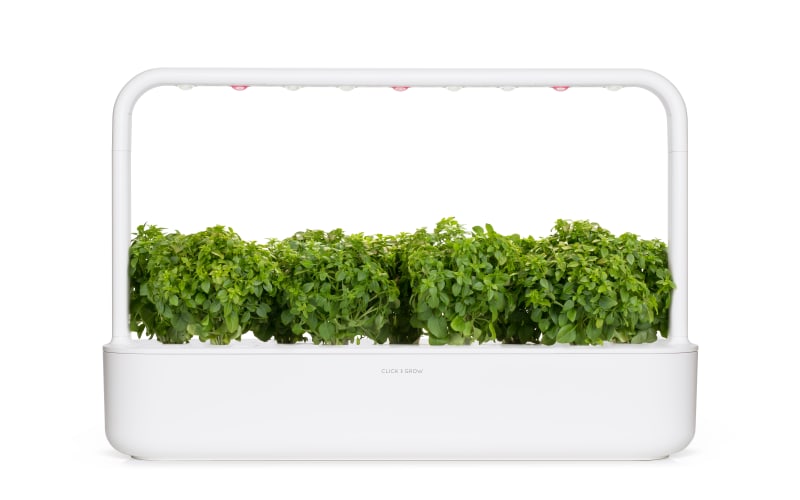
If you’re going to buy a Click & Grow, this is the model. Nine pods at $249.95 means you’re paying about $28 per pod slot, compared to $42 per slot on the Smart Garden 3. Better value, and nine pods gives you enough room to grow a mix of herbs, some lettuce, or even mini tomatoes alongside your basil.
The Smart Garden 9 comes with 3 tomato, 3 basil, and 3 lettuce pods in the box, which is a much better starter variety than the 3’s all-basil kit. Amazon reviewers who’ve run the SG9 for more than six months generally report good germination and consistent growth, with basil and lettuce doing the best and tomatoes being more hit-or-miss in terms of actual yield.
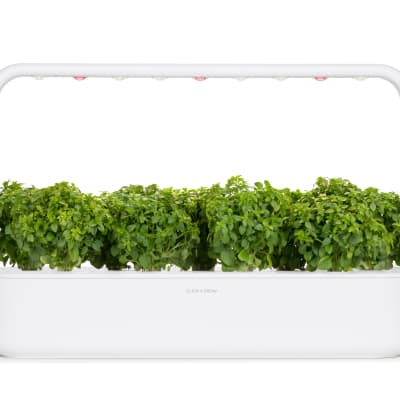 Click & Grow Smart Garden 9
Shop on Click & Grow
Click & Grow Smart Garden 9
Shop on Click & GrowThe design is the same minimal white look, just wider. It fits on a standard kitchen counter without looking absurd, though it does take up more real estate than the 3. If counter space is tight, measure first. The unit is about 23 inches wide.
The water reservoir is proportionally larger too, so you’re still looking at roughly two to three weeks between refills. For someone who travels for work or just doesn’t want to think about their garden during a busy week, that’s a legitimate advantage over any hydroponic system I’ve used.
Here’s the thing that makes me recommend the 9 over the 3: at nine pods, the ongoing pod cost starts to feel more reasonable because you’re getting actual variety. Three different herbs plus some greens is a real kitchen garden. Three basil plants is a novelty.
Skip the 9 PRO ($299.95)
The Smart Garden 9 PRO costs $50 more than the standard 9 and adds Bluetooth app connectivity. The app lets you adjust the light schedule and get reminders about when to water or add new pods.
I wouldn’t pay extra for it. Here’s why.
The standard Smart Garden 9 already has an automated light timer that works without the app. The watering situation is the same on both models, fill the tank when it’s low. Amazon reviewers report mixed experiences with the Bluetooth connectivity, with some saying it drops connection after a few months and others saying they stopped opening the app after the first week because the garden just runs itself without it.
The 9 PRO only has 30 reviews on Amazon compared to over 1,200 for the standard 9, which makes the 3.7-star rating hard to trust in either direction. But the broader pattern I see in reviews is that the Bluetooth features feel like a solution looking for a problem. Click & Grow’s whole appeal is that you don’t have to manage anything. An app to manage the thing you don’t have to manage is a weird product decision.
Save the $50. Get the regular 9.
The Pod Problem
This is where I get annoyed, and it’s the reason I returned my Smart Garden 3 in 2023.
Click & Grow pods are proprietary. They sell a “Grow Anything” blank pod where you add your own seeds, but multiple growers on Reddit describe germination as inconsistent compared to AeroGarden’s blank pods, which are just a simple sponge-and-basket setup that works with any seed. The Click & Grow ecosystem is built around you buying their pods.
Pod math for the Smart Garden 9, running 4 cycles per year:
- 9 pods per cycle at ~$3-5 each = $27-45 per cycle
- 4 cycles per year = $108-180 per year in pods alone
- Plus the $249.95 upfront cost
Compare that to an AeroGarden Bounty Basic at ~$180 upfront, where blank pods and bulk seeds run maybe $15-20 per year and nutrient alternatives cost $10-15 every few months .
By year two, the AeroGarden is dramatically cheaper to operate. That’s the trade-off you’re making with Click & Grow: zero effort in exchange for higher ongoing costs. Whether that’s worth it depends on how much you value never thinking about nutrients or pH. For some people that’s easily worth $100 extra per year. I don’t blame them.
When to Get an AeroGarden Instead
If you want to grow anything beyond herbs, get an AeroGarden. That’s the short version.
The AeroGarden Bounty Basic gives you 9 pods, 24 inches of grow height, true hydroponic growth with faster yields, and the ability to use any seeds you want for basically nothing. Tomatoes, peppers, lettuce, and larger herbs all do better in a hydroponic system because the roots have direct access to dissolved nutrients in the water.
🏆 Best Value Overall AeroGarden Bounty Basic
~$179.95
Check Price on Amazon
AeroGarden Bounty Basic
~$179.95
Check Price on AmazonI wrote a full comparison of Click & Grow vs AeroGarden and I still stand by the recommendation there: for most people, the AeroGarden is the better investment. It costs less over time, grows more variety, and teaches you something about how plants actually work.
But if you’ve tried hydroponic systems and gave up because the maintenance felt like a chore, or if you’re buying a gift for someone who just wants fresh basil without reading a single guide about pH levels, Click & Grow solves that problem better than anything else I’ve tested.
How to Save on Click & Grow
One thing I wish I’d known in 2023: buying directly from clickandgrow.com is usually a better deal than Amazon, especially with a discount code. The code SPROUTFLAT gets you 10% off your order on the Click & Grow website, which brings the Smart Garden 9 from $249.95 down to about $225.
That same 10% also applies to pod refills, which is where the real savings add up over time. If you’re spending $100+ per year on pods anyway, 10% off every order makes a noticeable difference.
Click & Grow also runs seasonal bundle deals (they’ve got a spring collection sale going right now with up to 35% off bundles) and a subscription option for pods that shaves off more per unit. I’d check the deals page before buying a garden at full price.
They also have a sprouting guarantee: if a pod doesn’t sprout, they’ll replace it free. That’s a nice safety net that you don’t get with third-party pods on Amazon.
Frequently Asked Questions
Is the Click & Grow Smart Garden actually hydroponic?
No. Click & Grow uses a peat-based growing medium called Smart Soil with nutrients embedded in it. Your plants grow in soil, not water. It’s a self-watering planter with an LED grow light. This matters because hydroponic systems like AeroGarden deliver nutrients faster and produce visibly larger plants over the same time period.
Can I use my own seeds in Click & Grow?
They sell “Grow Anything” blank pods, but the experience is clunkier than AeroGarden’s blank pods. Germination rates are less consistent according to Reddit growers, and the pod format doesn’t lend itself to DIY the way a simple sponge-and-basket setup does. This is Click & Grow’s biggest weakness for anyone who wants to experiment.
How long do Click & Grow pods last?
Most herb pods produce for two to three months. Lettuce grows faster, maybe six to eight weeks from planting to harvest. Mini tomato pods take longer, around three to four months, and the yield is small compared to a hydroponic setup. Expect a few tomatoes per cycle, not a harvest.
Is the Smart Garden 9 PRO worth the extra $50?
I don’t think so. The Bluetooth app control lets you adjust the light schedule and get reminders, but the standard Smart Garden 9 already has an automated light timer. Amazon reviewers report Bluetooth connectivity issues over time, and most say they stopped using the app within the first couple weeks because the garden runs itself without it.
Smart Garden 3 or Smart Garden 9?
The 9. At $125, the Smart Garden 3 gives you three pod slots, which means three plants total. That’s a novelty, not a garden. The Smart Garden 9 at $250 gives you nine slots and a much better starter variety kit (tomatoes, basil, lettuce). The per-pod cost is lower and you actually have room to grow different things.
Some links in this post are affiliate links. If you buy through a Click & Grow link, I may earn a commission at no extra cost to you. Use code SPROUTFLAT for 10% off.