
Fair warning: affiliate links ahead. I earn a small commission on purchases, which helps keep this site running. You pay the same either way.
Short answer: if you’re growing herbs in an AeroGarden with the branded liquid food, probably not. But if you’ve switched to third-party nutrients or you’re growing tomatoes or peppers, you’re flying blind without one. And if you’ve been Googling “TDS meter for hydroponics countertop garden” and getting results aimed at cannabis grows in 5-gallon buckets, that’s exactly the problem this article is trying to fix.
That’s the actual answer nobody else is giving you, because every TDS guide online is written for DWC setups and cannabis grows. The PPM targets they quote (100 - 1600 PPM across “growth stages”) will either panic you or mislead you entirely. This article is for countertop pod garden owners specifically, and the advice is different.
Quick Answer: Herb and lettuce growers using AeroGarden or iDOO branded nutrients can skip the TDS meter, the OEM formulas are pre-balanced and pH-buffered, designed to work without testing. But if you’ve switched to third-party nutrients like MaxiGro or GH Flora, or if you’re growing tomatoes or peppers, a meter pays for itself in the first grow. A basic combo pen runs about $15 - 30 on Amazon and takes the guesswork out of dosing.
| Product | Price | Rating | Key Feature | |
|---|---|---|---|---|
 Water Quality Tester Water Quality Tester | ~$13.39 | 【Energy Efficient and Durable】This water quality tester not only provides accura | Check Price | |
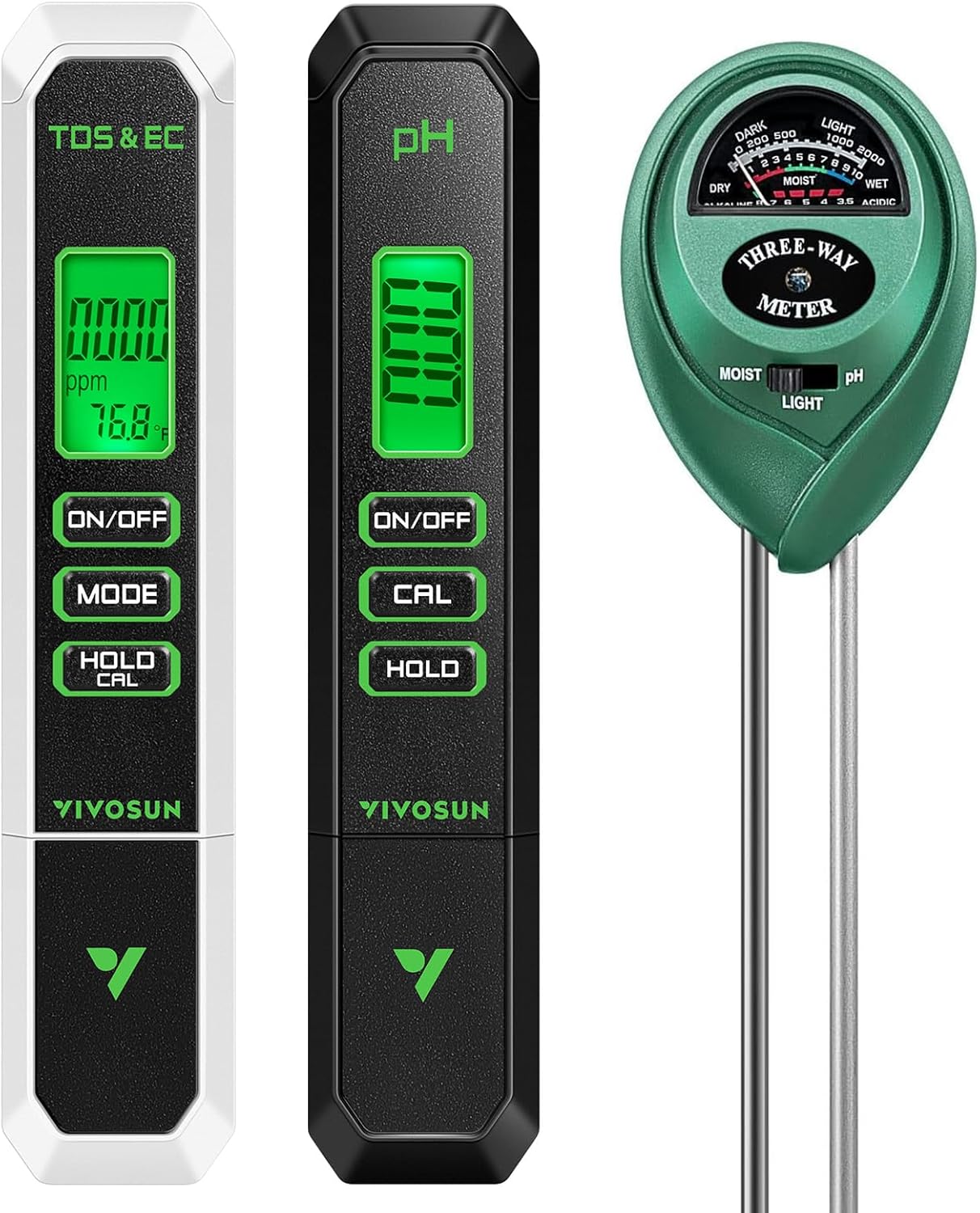 VIVOSUN Digital pH Meter VIVOSUN Digital pH Meter | ~$28.99 | 4.1★ (1,291) | Measures pH levels from 0.00 to 14.00 with ±0.1 pH accuracy; Features one-touch | Check Price |
 VIVOSUN Digital PH Meter VIVOSUN Digital PH Meter | ~$23.99 | 4.1★ (415) | This set includes a digital pH meter, a 3-in-1 TDS meter, and a 3-in-1 soil test | Check Price |
 Bluelab Combo Meter for pH/EC/Temp + Bluelab Combo Meter for pH/EC/Temp + | ~$289.99 | Compatible Protective Case + Digital Meter, Includes the Bluelab Combo Meter (p | Check Price |
Why OEM Nutrients Don’t Need a Meter (Usually)
AeroGarden’s liquid plant food is pH-buffered. That’s the part most people don’t know. It has a built-in stabilizer that keeps the pH in a reasonable range for most tap water sources, which is exactly why you can follow their schedule, pour it in, and have basil go gangbusters without testing anything.
Same logic applies to iDOO and most other branded pod garden nutrients. They’re formulated for convenience. Think of it the way one r/aerogarden user framed it: AeroGarden nutrients are like Keurig K-cups versus drip coffee, you give up some control, but the tradeoff is that it’s hard to get it catastrophically wrong.
So for herbs and lettuce, on OEM nutrients, following the recommended doses? You probably don’t need a meter. That’s the honest answer.
The problem is when that formula stops applying.
When You Actually Need One
Two scenarios where a TDS meter stops being optional:
You switched to third-party nutrients. MaxiGro, General Hydroponics Flora Series, MasterBlend, these require you to mix your own concentration. There’s no pre-balanced formula doing the work. And without a meter, you’re guessing. A r/aerogarden user recently posted about dosing OEM nutrients and measuring 80 PPM, barely above plain tap water. The community response was immediate: “80 PPM is like tap water. Give those plants some food.” That kind of mistake is easy to make when you’re eyeballing a powder.
You’re growing fruiting plants. Tomatoes and peppers need roughly 1200 - 1800 PPM during flowering and fruiting. According to multiple experienced growers in r/aerogarden, AeroGarden’s own feeding schedule never gets fruiting plants anywhere near that level, which explains why the sub is full of posts about curling leaves and browning edges on pepper plants. As one grower with a Farm 12 put it: peppers and tomatoes show signs of deficiency when you follow OEM dosing, the schedule just wasn’t built for high-demand crops.
If either scenario applies to you, a TDS meter isn’t a nice-to-have. It’s the thing that tells you why your plants look terrible.
The PPM Reference Chart Nobody Gives You
Every guide online quotes cannabis PPM targets. Here’s a countertop-garden-specific version:
| Crop Type | Target PPM Range |
|---|---|
| Herbs (basil, cilantro, dill) | 500 - 700 PPM |
| Lettuce and leafy greens | 560 - 840 PPM |
| Tomatoes and peppers (flowering/fruiting) | 1200 - 1800 PPM |
One experienced r/aerogarden grower who monitors TDS across a Farm 12 and a Sprout targets 550 - 900 PPM for lettuce and herbs, and pushes to 1400 - 1800 PPM for tomatoes and peppers. Those numbers roughly match what I’ve seen across Reddit and the shershegrows hydroponic guide.
Worth noting: a YouTube grower running a Farm XL with MaxiGro and AeroGarden nutrients side by side uses slightly higher targets (800 - 1200 PPM for lettuce, ~2000 PPM for tomatoes), probably because larger systems with more mature plants demand more. For a 1-gallon AeroGarden Harvest, I’d stay toward the lower end.
The Conversion Factor Problem
That confuses beginners more than anything else: two different TDS pens measuring the exact same water can give readings that are 40% apart. And both are technically “working.”
Most cheap TDS pens measure EC (electrical conductivity) and then multiply it by a conversion factor to give you a PPM number. The problem is that different manufacturers use different factors: 0.5, 0.64, or 0.7. So a reading of 1.5 mS/cm EC becomes 750 PPM on one meter, 960 on another, and 1050 on a third. Same water. Same plants. Wildly different numbers.
This is why a beginner with a $10 pen and a $15 pen can get a 300 PPM difference and spend an afternoon convinced something is wrong with their nutrient solution. It’s annoying, and nobody prints the conversion factor on the front of the device where it would actually be useful.
The fix is to check which scale your meter uses (it’s usually in the manual or on the Amazon listing) and use that consistently. If you want to compare numbers across devices or with what you read on Reddit, EC is the more reliable unit, it’s universal and doesn’t vary by conversion factor. The downside is that EC is less intuitive for beginners. PPM feels like a real number; EC in mS/cm doesn’t mean much until you’ve used it for a while.
My own tap water is 8.7 pH, which I found out after months of yellowing basil. I’d had the same basil problem I wrote about in my first growing season, and it turned out to be pH, not nutrients, not light, not anything complicated. A meter would have caught it faster.
Small Reservoirs Swing Faster Than You Think
One thing the DWC guides completely miss: countertop pod gardens have tiny reservoirs. The AeroGarden Harvest holds about 1 gallon. The Bounty is around 1.5 gallons. Even a 12-pod iDOO isn’t much more.
In a small reservoir, PPM swings fast. Plants drink water faster than they drink nutrients, so your concentration rises over the week. In a 5-gallon DWC bucket, that’s gradual. In a 1-gallon Harvest, it can jump 100 - 200 PPM between your weekly top-offs if you’re not adding plain water to compensate. This makes checking TDS more useful for countertop systems, not less, but it also means adjustments are smaller. A splash of water, not a full reservoir overhaul.
But that’s the part most countertop growers don’t realize until they’ve been puzzling over creeping PPM numbers for a few weeks.
Which Meter to Buy
For most countertop gardeners, a basic combo pen is plenty. The VIVOSUN Digital pH Meter + TDS/EC Pen buy on Amazon is one of the more common options on Amazon, the reference price I’ve seen is around $29. It gives you both measurements without spending much. Decent starting point, especially if you’re still on OEM nutrients and just want occasional reassurance.
If you’ve switched to third-party nutrients or you’re running fruiting plants, I’d step up to the VIVOSUN 3-in-1 combo check current price (check current price on Amazon), which measures pH, TDS, EC, and temperature in one device and includes automatic temperature compensation. That last part matters if your tap water is cold in winter, uncompensated readings can drift meaningfully at low temperatures. Amazon reviewers like it for the price, though the common complaints are real: the pH probe drifts and needs recalibration more often than you’d want, and at least one reviewer flagged the soil tester as unreliable for actual soil pH. The TDS/EC side holds up better. For hydroponics, that’s kind of par for the course with anything under $50.
For the serious end of the spectrum: the Bluelab Combo Meter see on Amazon is the tool people trust in actual grow rooms. It’s $100+, doesn’t need frequent recalibration, and gives reliable readings without drama. Overkill for a 6-pod herb garden. Worth it if you’re running multiple systems or growing tomatoes seriously.
I personally haven’t felt the need to go above the basic combo pen for my herb rotation, but if I ever commit to fruiting plants beyond the strawberry experiment I’m currently running in the iDOO, I’d move up.
And honestly, the upgrade from basic pen to 3-in-1 is only a few dollars, so if you’re already buying one, you might as well get the temperature compensation.
Also: the article on AeroGarden nutrient alternatives goes into more detail on switching from OEM to third-party nutrients, which is the main scenario where you’ll actually need a meter.
Frequently Asked Questions
Do I need a TDS meter for hydroponics?
Not always. If you’re using branded nutrients like AeroGarden liquid food and growing herbs or lettuce, the formula is designed to work without testing. But if you’re mixing your own nutrients or growing tomatoes or peppers, you need one, there’s no reliable way to dose correctly without measuring what’s actually in your water.
What should TDS be for hydroponics?
For a countertop pod garden: herbs around 500 - 700 PPM, lettuce 560 - 840 PPM, and fruiting plants like tomatoes and peppers 1200 - 1800 PPM when they’re actively flowering or fruiting. These are lower than what you’ll see in DWC or cannabis guides, which aren’t written for small-reservoir systems.
How to lower TDS in hydroponics?
Add plain water. In a small reservoir, TDS rises over the week because plants drink water faster than nutrients. Topping off with plain pH-adjusted water brings it back down without dumping the whole reservoir. If it’s chronically high, you may be overdosing nutrients, back off the amount you’re adding per the feeding schedule.
What is the best PPM for hydroponics?
It depends on the crop. For herb and lettuce growers on countertop systems, anywhere in the 500 - 840 PPM range is generally fine. For fruiting plants, you need to push higher, 1200 - 1800 PPM during peak fruit production. The 100 - 1600 PPM ranges you see in most guides are for cannabis, and they’ll mislead you.
What is the difference between EC and PPM in hydroponics?
EC (electrical conductivity) measures how well your water conducts electricity, which tells you how much dissolved stuff is in it. PPM (parts per million) is just EC converted to a more intuitive number. The problem is that cheap meters use different conversion factors (0.5, 0.64, or 0.7), so the same water can read 750 PPM on one meter and 1050 PPM on another. EC is universal, no conversion factor variation. PPM is easier to understand but only trustworthy if you know which scale your meter uses.
How do I use a TDS meter in my AeroGarden?
Dip the probe end into your reservoir water, wait for the reading to stabilize (usually 5 - 10 seconds), and check the number. Do it before you add nutrients to get your baseline, then after to confirm you’re in range. For the AeroGarden Harvest’s 1-gallon reservoir, even small changes to nutrient dose will move the PPM noticeably, so go slow and remeasure. If your reading is consistently lower than expected, you’re probably under-dosing. If it’s climbing week over week without adding nutrients, top off with plain water.
One more thing worth keeping in mind: if you’re troubleshooting yellow leaves or stunted growth, check out why your AeroGarden plants keep dying before assuming it’s a nutrient concentration problem. In my experience, pH issues and light problems cause more plant deaths in countertop systems than anything TDS-related, and both of those are worth ruling out first.