
Two full grows with cherry tomatoes that looked right but tasted like nothing and weighed almost nothing. Tiny fruit, barely any set, leaves with brown edges I kept blaming on the light. The third grow I switched hydroponic nutrients for my countertop garden. The difference wasn’t subtle.
If you’re growing herbs or lettuce in a countertop system, the nutrient question is mostly solved. Stick with what came in the box or grab a cheap alternative and you’ll be fine. But if you’ve got tomatoes or peppers that are struggling, look small, or just aren’t setting fruit, the nutrients are probably why. And it’s not random bad luck, there’s a specific chemistry reason it happens.
Quick Answer: For herbs and lettuce in a countertop hydroponic garden, AeroGarden’s liquid nutrients or any simple A&B two-part formula works fine. For fruiting plants like tomatoes and peppers, you need something with calcium and a higher PPM ceiling, either GH MaxiGro plus Cal-Mag, or the GH Flora Series three-part. The included single-bottle nutrients can’t physically contain calcium without forming insoluble sludge, which is why your tomatoes are struggling. (Quick note: AeroGarden shut down in early 2025 and relaunched under Scotts Miracle-Gro, the liquid is still available, just worth knowing the brand had a rough year before you stock up.)
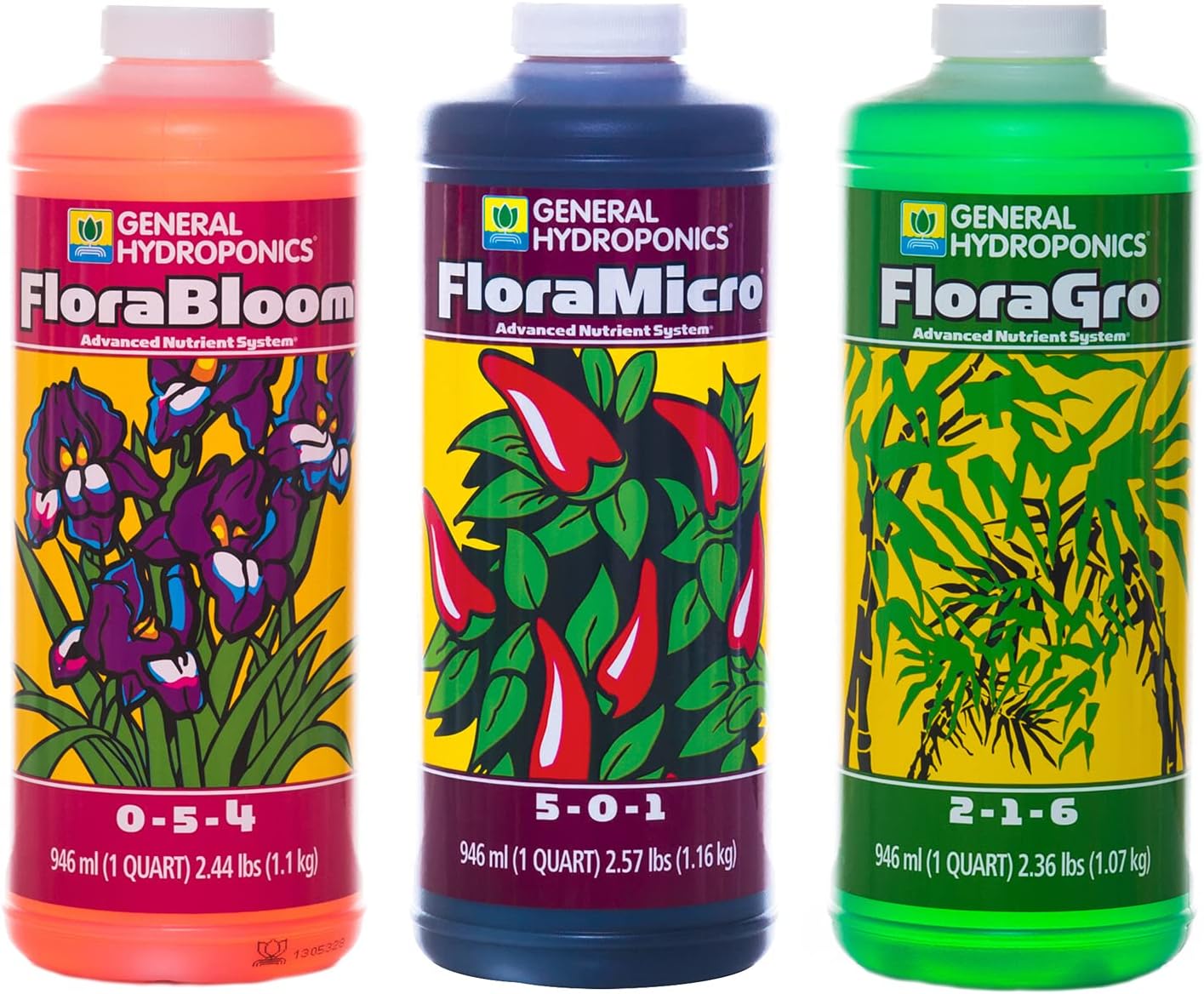 General Hydroponics Flora Series: FloraMicro, FloraBloom, ...
Three-part synthetic nutrient system (micro, bloom, grow) for customizable hydroponic feeding across all plant growth stages
~$32.86
General Hydroponics Flora Series: FloraMicro, FloraBloom, ...
Three-part synthetic nutrient system (micro, bloom, grow) for customizable hydroponic feeding across all plant growth stages
~$32.86
 inbloom Hydroponic Nutrients (1000 ml in ...
1000 ml two-part hydroponic nutrient solution with balanced macro and trace elements, suitable for vegetables, herbs, flowers, and houseplants across all growth stages
inbloom Hydroponic Nutrients (1000 ml in ...
1000 ml two-part hydroponic nutrient solution with balanced macro and trace elements, suitable for vegetables, herbs, flowers, and houseplants across all growth stages
 Ahopegarden 800ml A&B Hydroponic Nutrients ...
800ml two-part A&B nutrient concentrate for multiple hydroponic growth cycles, compatible with all systems
~$9.99
Ahopegarden 800ml A&B Hydroponic Nutrients ...
800ml two-part A&B nutrient concentrate for multiple hydroponic growth cycles, compatible with all systems
~$9.99
 ENVY Hydroponic Plant Food A & B – Two-Part Liquid ...
Two-part concentrated hydroponic nutrient formula with 5% calcium and chelated iron, designed for simplified feeding throughout complete grow cycles.
~$98.99
ENVY Hydroponic Plant Food A & B – Two-Part Liquid ...
Two-part concentrated hydroponic nutrient formula with 5% calcium and chelated iron, designed for simplified feeding throughout complete grow cycles.
~$98.99
What Hydroponic Nutrients Actually Are
Nothing mysterious here. Hydroponic nutrients are just mineral salts dissolved in water. Potassium nitrate, calcium nitrate, mono potassium phosphate, magnesium sulfate. The same elements plants pull from healthy soil, delivered directly to the roots in a form they can absorb immediately. No soil bacteria required, no decomposition waiting period.
The reason you can’t substitute soil fertilizer is mostly about solubility and concentration. Soil fertilizers are designed to break down slowly and interact with soil chemistry. Dump them in a reservoir and you’ll get inconsistent absorption at best, a cloudy mess or root burn at worst. Hydroponic-formulated nutrients dissolve cleanly and are designed to stay in solution.
That’s it. No weird science. Just dissolved minerals.
The Calcium Gap Nobody Explains
Here’s why AeroGarden’s single-bottle formula underperforms for fruiting plants, and why it’s not really AeroGarden’s fault.
Calcium doesn’t play well with sulfates or phosphates in solution. When you try to combine them in one bottle at high concentration, they bond and form insoluble compounds that fall out of solution as a white precipitate. It’s just chemistry. So AeroGarden’s single-bottle formula leaves calcium out entirely. That keeps the product stable and shelf-stable, but it means every feeding is calcium-deficient by design.
For basil, cilantro, or lettuce, that’s mostly fine. Leafy plants don’t need a lot of calcium. But fruiting plants, tomatoes, peppers, cucumbers, use calcium heavily during fruit development. Without it, you get blossom end rot, deformed fruit, and the specific set of symptoms a user on r/aerogarden described pretty well: curled leaves, browning edges, little spots, deformed leaves, fruit that barely sizes up.
The PPM problem compounds this. A Reddit user named zbertoli documented it in detail: AeroGarden’s standard feeding schedule delivers roughly 400-600 PPM. Tomatoes and peppers in flowering want closer to 1200 PPM. That’s not a small gap. You’re feeding fruiting plants at half the concentration they need, while also leaving out a mineral they need a lot of. No wonder the fruit is tiny.
Herbs and Greens vs. Fruiting Plants: A Simple Decision Split
The decision tree here is pretty short.
Growing herbs, lettuce, greens, or radishes? Any decent single-bottle liquid or A&B two-part formula works. AeroGarden’s liquid is fine. A generic A&B like Ahopegarden buy on Amazon or inbloom check current price at 5ml A + 5ml B per liter is fine. GH MaxiGro at 1/2 tsp per liter is fine. Pick whichever is cheapest or easiest.
Growing tomatoes, peppers, cucumbers, or anything fruiting? You need calcium in the formula and a higher PPM ceiling. That means either GH MaxiGro plus a separate Cal-Mag supplement, or the GH Flora Series three-part where FloraMicro provides the calcium. A basic A&B won’t cut it for fruiting plants for the same reason AeroGarden’s formula doesn’t: most budget two-parts are also low on calcium.
That’s the whole decision. Everything else is just details about which product to buy within those two categories.
The Four Nutrients I’ve Used or Tested
AeroGarden liquid nutrients, included with most systems, about $20 for a 1-liter refill if you check Amazon. pH buffered, which matters more than people realize. When I was growing basil in year one and getting yellowing I couldn’t explain, part of the issue was pH drift. The buffering in AeroGarden’s formula helps prevent that. For herbs, it works. The cost adds up over time, I wrote more about that at /posts/aerogarden-nutrients-are-expensive-here-are-4-cheaper-alternatives-that-actually-work/ . But for a beginner running basil and cilantro, I don’t think there’s a compelling reason to switch immediately. One thing worth flagging: AeroGarden went through a shutdown in January 2025 and relaunched under Scotts Miracle-Gro in spring 2025. The liquid is back in stock and the brand is currently operational, but if you’re planning to buy a year’s supply at once, it’s worth keeping in mind that the brand stability picture is less certain than it was a few years ago.
GH MaxiGro powder, costs around $16 for a 2.2 lb bag last I checked, though prices shift so worth verifying on Amazon. That bag makes an absurd number of 1-liter solutions at 1/2 tsp per liter. The cost difference versus AeroGarden liquid is significant enough that it’s the obvious long-term choice for anyone mixing their own water. The catch: it’s a powder. You dissolve it in water first, wait for it to fully dissolve before checking pH, then add it to the reservoir. Takes a few minutes. Also lowers pH noticeably, so you’ll want pH Up on hand. A Reddit user named Feelfree42 gave the most practical dosing I’ve seen: 1/2 tsp per gallon for seedlings, up to 1 tsp per gallon for mature plants. For cherry tomatoes, a YouTube creator who tested MaxiGro solo against AeroGarden branded nutrients found the results “extremely close”, that’s enough permission to switch.
The powder-vs-liquid thing matters more than it sounds for apartment growing. I don’t have a utility room or extra cabinet space. A 2.2 lb bag of powder stores flat in a drawer. A bunch of liquid bottles don’t.
GH Flora Series three-part see on Amazon , this is what I switched to for the third tomato grow. Fruit set went from maybe 6-8 tiny tomatoes per cycle to something that actually felt worth the grow time, I stopped blaming the light. FloraMicro contains nitrogen, calcium, and trace minerals. FloraGro is for vegetative growth. FloraBloom handles fruiting and flowering. You adjust the ratios depending on growth stage, which gives you actual control over what your plant is getting when it needs it.
One thing nobody else seems to mention: mixing order matters a lot. FloraMicro goes in first, every time. Then FloraGro or FloraBloom. If you add them all at once or in the wrong order, you get precipitation, the minerals bond with each other before they can dissolve properly. A Reddit user named vif911 described it well: it’s like comparing Keurig pods to a drip machine. More steps, more control, better results if you do it right. The learning curve is real but it’s not steep.
ENVY A&B two-part check price on Amazon , I haven’t run a full cycle with this one yet, I’m partway through a basil grow, but the two-part formula design solves the calcium problem that kills AeroGarden’s single-bottle. Two-part formulas separate incompatible minerals (calcium in one bottle, phosphates and sulfates in the other), which is the right approach. For someone who wants better nutrient coverage than AeroGarden liquid but doesn’t want to manage three separate bottles, this is the middle option worth considering.
One real caveat, though: ENVY has shipping restrictions that cut off some buyers entirely. A handful of reviewers mentioned suddenly losing access with no clear explanation. And if you’re trying to keep nitrogen on the lower side during fruiting, the NPK profile skews higher-nitrogen than ideal for that stage.
And honestly, the fact that nutrient companies don’t put this calcium compatibility issue on the front of the label is annoying. You find out the hard way, after two disappointing tomato grows, or you stumble across a Reddit thread where someone finally explains the chemistry. It shouldn’t be that obscure.
🌿 Best for Serious Growers
General Hydroponics Flora Series: FloraMicro, FloraBloom, ...
Three-part synthetic nutrient system (micro, bloom, grow) for customizable hydroponic feeding across all plant growth stages
Check Price on AmazonPractical Tips That Actually Matter
The topping-off trap. In a small countertop reservoir, water evaporates faster than nutrients get consumed. If you top off the reservoir with more nutrient solution instead of plain water, you’re slowly concentrating the tank. Eventually you’ll have nutrient burn on the roots and crispy leaf tips and no idea why. The fix is simple: top off with plain pH-adjusted water between change days. Add nutrients on scheduled change days only.
Wait after mixing MaxiGro before checking pH. The powder lowers pH as it dissolves, but it doesn’t finish dissolving instantly. If you mix it and immediately check pH, you’ll get a reading that’s still shifting. Wait at least a few hours, then adjust. Feelfree42 on r/aerogarden recommends about 1ml of pH Up solution after mixing, which lines up with my experience.
The included nutrients might already be bad. One user on r/Hydroponics reported their iDOO-included nutrients went moldy quickly. I didn’t have that exact problem with mine, but I’d check the included bottle before assuming it’s fine. If anything looks off, just replace it. The bottle that comes in the box isn’t precious.
A PPM meter is more useful than a pH meter for troubleshooting fruiting plants. This surprised me. zbertoli from that r/aerogarden thread put it directly: “I think ppm meter is more important than the pH.” If you’re getting deficiency symptoms on tomatoes, check your PPM first. If you’re at 400-600 and following AeroGarden’s schedule, that’s likely your problem before pH even enters the picture.
This article is part of my Hydroponic Nutrients Guide , a complete resource for countertop hydroponic growing.
Frequently Asked Questions
Can I use any hydroponic nutrient in my AeroGarden or iDOO?
Mostly yes, with one condition: make sure whatever you use is formulated for hydroponics, not soil. Soil fertilizers are designed to interact with soil chemistry and won’t behave correctly in a water reservoir. As long as a nutrient says it’s intended for hydroponic use, it’ll work in any countertop system including AeroGarden and iDOO. The only other thing to watch is pH, if your nutrient isn’t buffered like AeroGarden’s liquid is, you’ll want to check and adjust pH after mixing.
What’s the difference between one-part, two-part, and three-part hydroponic nutrients?
One-part formulas (like AeroGarden’s liquid) put everything in a single bottle, which is convenient but forces the manufacturer to leave out calcium since it forms insoluble compounds with the other minerals. Two-part formulas separate calcium from phosphates and sulfates so you get a more complete mineral profile without precipitation. Three-part formulas like GH Flora Series give you stage-specific control, different ratios for seedling, vegetative, and fruiting stages. More parts means more flexibility and better results for fruiting plants, and more steps to mix correctly.
How much MaxiGro should I use in a countertop pod garden?
For herbs, lettuce, and greens: 1/2 tsp per liter of water (or 1/2 tsp per gallon if you’re mixing a larger batch). For mature fruiting plants like tomatoes or peppers: up to 1 tsp per liter. Start on the lower end. MaxiGro also drops pH a lot when dissolved, so mix it first, wait a few hours, then check and adjust pH before adding to your reservoir.
Why are my tomato plants in my AeroGarden not producing much fruit?
Two things are probably happening at once. First, AeroGarden’s standard feeding schedule keeps your reservoir at around 400-600 PPM, and tomatoes in flowering want closer to 1200 PPM. Second, the single-bottle formula omits calcium, which is something tomatoes need a lot of during fruit development. The symptoms are pretty recognizable: curled leaves, browning edges, small or deformed fruit. Switching to GH MaxiGro plus a Cal-Mag supplement, or the GH Flora Series three-part, usually fixes this. More on this at /posts/how-to-grow-cherry-tomatoes-in-a-countertop-hydroponic-system-without-them-taking-over/ .
Do I need different nutrients for herbs vs fruiting plants?
For herbs and leafy greens, a basic one-part or two-part formula is enough. For fruiting plants, you need a formula that includes calcium and supports higher PPM levels during flowering. It’s not that herbs have simpler needs exactly, it’s that fruiting plants have specific additional needs that basic formulas don’t meet. If you’re only growing basil and lettuce, don’t overthink it. If you’re adding tomatoes or peppers, switch to something with calcium in the formula.
What are hydroponic nutrients made of?
Mineral salts, mostly. The same elements that exist in healthy soil: potassium nitrate, calcium nitrate, mono potassium phosphate, magnesium sulfate. Nothing exotic. They’re just formulated to dissolve cleanly in water and be immediately available to plant roots, rather than slowly breaking down in soil over time. There’s nothing alarming in a standard hydroponic nutrient formula.
Should I use liquid or powder nutrients for a small indoor garden?
Depends on how you’re set up. Liquid is easier, especially buffered formulas like AeroGarden’s that handle pH automatically. Powder like GH MaxiGro is dramatically cheaper per feeding and takes up much less storage space, which matters a lot in a small apartment kitchen. The extra step of dissolving it first is minor once you’ve done it a few times. If cabinet space is tight and you’re feeding more than one system, powder makes more practical sense.
How often should I change the water and nutrients in my countertop garden?
Every 1-2 weeks is the standard recommendation for most countertop pod systems. Between changes, top off with plain pH-adjusted water only, not nutrient solution. Adding more nutrient solution to top off concentrates the tank over time and leads to nutrient burn. On actual change days, dump and rinse the reservoir, then mix fresh nutrient solution from scratch. If you’re running GH nutrients instead of AeroGarden’s buffered formula, rinsing before each refill becomes more important for keeping pH stable between changes.