
One basil plant. One pod. Nine months of fresh leaves. Growing basil hydroponically indoors is one of the best uses for a countertop system, and most guides undersell how long a single plant can run.
Most beginner guides imply you’ll be swapping pods every 8-10 weeks. And if you don’t prune correctly, that’s exactly what happens, your plant bolts, the leaves turn bitter, and you start over. But basil in a countertop hydroponic setup can run 220-300 days if you treat it right. I’ve seen plants keep going for nearly 300 days. Another hit 220 before the plant finally gave out naturally. That’s basically a year of pesto from a single $3 pod.
Nobody tells you this upfront. This guide does.
Quick Answer: Basil is one of the best crops for countertop hydroponics, fast to germinate, forgiving on nutrients, and capable of running 220-300 days with correct pruning. Start seeds in a standard grow sponge, keep pH at 5.8-6.2, and prune above the second or third node every 7-10 days. The moment you see flower buds, cut them off. That one habit is the difference between a plant that lasts 6 weeks and one that lasts 9 months.
 Gourmet Herbs Seed Pod Kit for AeroGarden, iDoo ...
12-pod replacement kit with heirloom herb seeds and growing supplies, compatible with AeroGarden and similar hydroponic systems
~$24.99
Gourmet Herbs Seed Pod Kit for AeroGarden, iDoo ...
12-pod replacement kit with heirloom herb seeds and growing supplies, compatible with AeroGarden and similar hydroponic systems
~$24.99
 12-Pod Gourmet Herb Basil Seed Pod Kit for AeroGarden ...
12-pod hydroponic herb seed kit with seven varieties and nutrient solution, ideal for indoor herb gardening in compatible systems
~$24.99
12-Pod Gourmet Herb Basil Seed Pod Kit for AeroGarden ...
12-pod hydroponic herb seed kit with seven varieties and nutrient solution, ideal for indoor herb gardening in compatible systems
~$24.99
 Hydroponics Seed Pod with Genovese Basil & Purple ...
8-pod seed kit with Genovese and purple basil seeds, compatible with most hydroponic systems for year-round indoor herb growing
~$19.99
Hydroponics Seed Pod with Genovese Basil & Purple ...
8-pod seed kit with Genovese and purple basil seeds, compatible with most hydroponic systems for year-round indoor herb growing
~$19.99
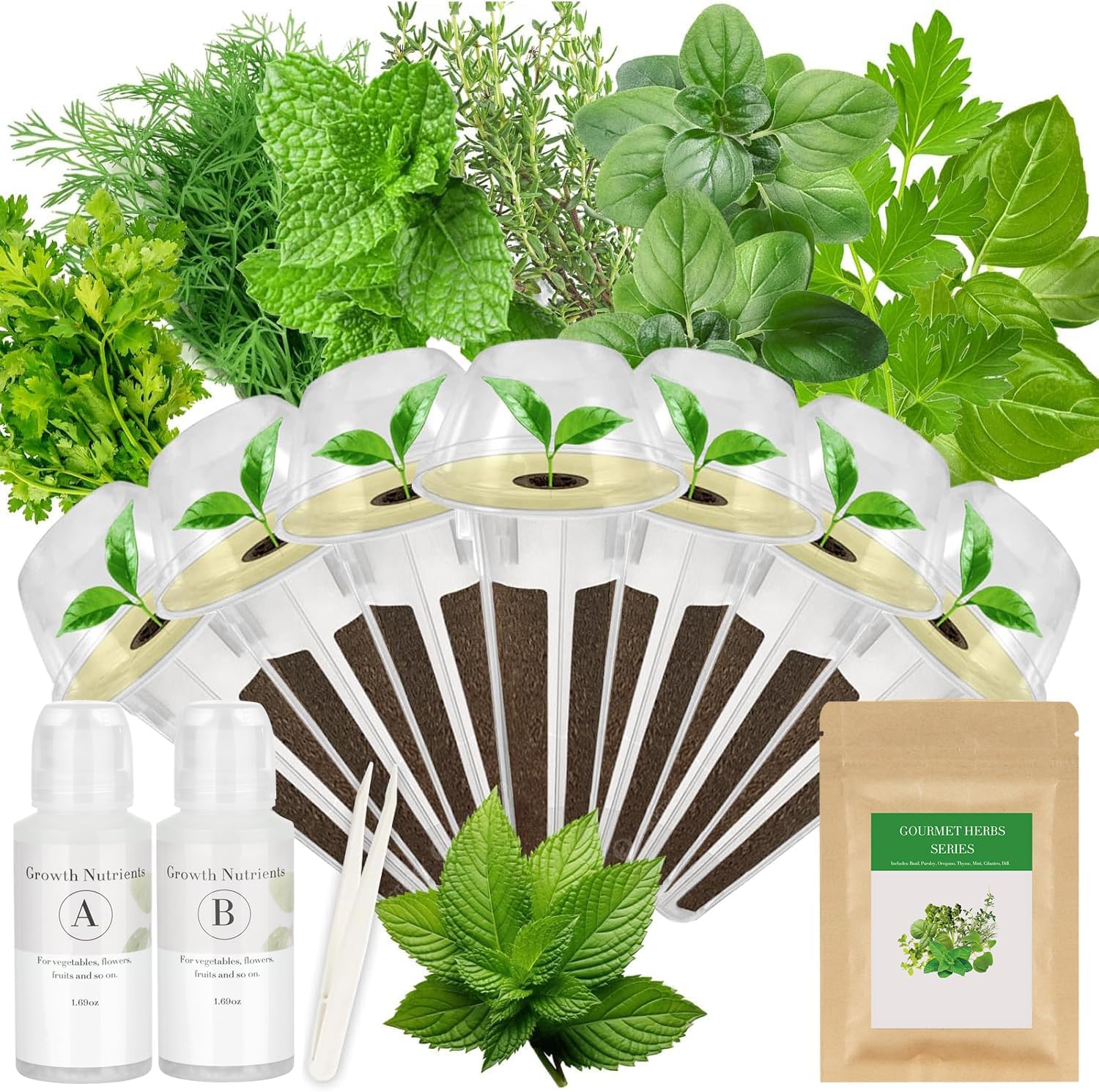 Gourmet Herb Seed Pod Kit for AeroGarden, idoo, Ahopegarden ...
Refill kit with 7 herb varieties, grow sponges, nutrients, and accessories compatible with multiple hydroponic systems for continuous harvests
~$16.98
Gourmet Herb Seed Pod Kit for AeroGarden, idoo, Ahopegarden ...
Refill kit with 7 herb varieties, grow sponges, nutrients, and accessories compatible with multiple hydroponic systems for continuous harvests
~$16.98
Why Basil is the Right Starting Crop
Experienced hydro growers call leafy herbs “hydro on easy mode,” and basil earns that more than almost anything else. It germinates fast, doesn’t need precise EC management the way tomatoes do, and responds well to beginner-level pruning. Basil reaches harvest-ready in approximately 28 days under optimal hydroponic conditions. First harvests can come as early as 14 days with Dwarf Greek varieties.
The yield-per-pod math is also just better than most people expect. Fresh basil at the grocery store runs $3-4 for a small bunch that wilts in three days. A single hydroponic pod, properly maintained, will outproduce that within the first month and keep going for months after. For anyone who cooks with basil regularly, pesto, Caprese, pasta, the calculus is obvious.
Variety Guide: Match Your Basil to What You’re Actually Cooking
All basil is not the same plant for cooking purposes, and variety choice matters more than most pod kit descriptions let on.
Genovese is the classic. Heavily cupped, spoon-shaped leaves, that deep anise-forward aroma that makes pesto taste right. It’s the preferred type for culinary use, and for good reason. If you’re making pesto or Caprese, this is the one.
Italian Large Leaf grows faster and yields more than Genovese. The leaves are thicker, slightly sweeter, a little less aromatic. Good for pasta and cooked applications where you want bulk. Not quite right for raw Caprese where the flavor is the whole point.
Dwarf Greek Basil is my favorite for long-term countertop growing. Tiny leaves, compact habit, and it’s the variety least prone to bolting. Fast, productive, long-living, and low-maintenance, all you need to do is harvest aggressively. First harvests as early as 14 days.
Thai Basil (Siam Queen is the common variety) is a totally different flavor profile, more anise and clove, less sweet. It’s the one for stir-fry, pad thai, green curry. Worth noting: Thai basil flowers aggressively. You’ll be pinching buds constantly, but the flavor from the leaves is worth it.
Lemon Basil is niche but useful if you cook fish, make cocktails, or want to do anything with lemonade or fruit desserts. Grows well hydroponically but it’s not a first-pod choice.
Setup: Seeds vs. Pods, Sponge Tips, and Spacing
You have two options: branded seed pod kits or third-party kits with your own seeds.
Branded pods are convenient but the cost-per-pod math is not great, I’ve written about this at length in my pod alternatives article . Third-party kits that include grow sponges, baskets, domes, and seeds are a better deal for repeat growers.
The Gourmet Herb Seed Pod Kit for AeroGarden, idoo, Ahopegarden buy on Amazon from apoloseedic is one of the more reasonably priced options at around $17 for a 7-pod kit with basil, parsley, thyme, mint, cilantro, dill, and oregano. It fits AeroGarden and iDOO systems well and sprouts quickly. The common complaint is that placing tiny seeds into small sponges is fiddly work, the domes don’t snap on securely either, they just sit on top. Fair warning.
Gourmet Herb Seed Pod Kit for AeroGarden, idoo, Ahopegarden ...
Refill kit with 7 herb varieties, grow sponges, nutrients, and accessories compatible with multiple hydroponic systems for continuous harvests
Check Price on AmazonIf you want more variety or a larger kit, the Gourmet Herbs Seed Pod Kit check current price covers 12 herb types including basil, and the pods are practically identical to official AeroGarden pods. Same fiddly seed placement issue applies. And honestly, the fact that AeroGarden’s own blank “Grow Anything” kits cost nearly the same per pod as their seeded kits is annoying, there’s no good reason for that pricing, and it’s exactly why third-party alternatives exist.
I’ve seen better results with third-party heirloom seeds than with branded pods, planting from seed with sponges bought separately, using varieties like Lettuce Leaf basil and Thai Siam Queen. Plants at 23 days can look noticeably healthier than typical branded-pod results.
For spacing: basil gets big. Faster than you expect. If you’re running a 6-pod system, don’t plant basil in every slot. Two, maybe three pods of basil with one or two slots left open gives it room to spread without crowding. Basil does best in isolation from other crops when possible, partly because its ideal EC is different from most herbs.
Put 2-3 seeds per sponge. Thin to one plant per pod after sprouting. That’s it.
The Pruning Method (Week by Week)
This is where most guides fail you. “Prune when it gets to 6 inches” is not enough information. Here’s what an actual schedule looks like.
Week 2: First pinch. When the plant hits around 6 inches, pinch off the top set of leaves right above the first node where smaller leaves are sprouting. Don’t harvest anything yet, you’re just directing growth.
Weeks 3-4: First real harvest. The plant has branched. Now cut each stem above the second or third node from the top, not at the base. You want 2-4 inches of stem below the cut with at least one set of leaves remaining. This is the key move. Cut too low and you remove all the growth nodes. Cut above a node and the plant forks into two new branches.
Weeks 5 onward: Harvest every 7-10 days. Every time you cut above a node, you get two branches. Those two branches become four cutting points next cycle. The plant doubles its output capacity with each round, which is why a well-pruned basil gets more productive over time rather than less.
The exact cut: find a node where small leaves are already sprouting out from the main stem. Cut just above that node, maybe a quarter inch above it. That node becomes the new growing tip. Do this to every branch, every 7-10 days.
Flower buds? Cut them immediately. The moment you see them.
EC, Nutrients, and Why You Should NOT Push Basil Hard
Here’s something no other guide connects clearly: AeroGarden’s default nutrient dosing is actually close to ideal for basil flavor. You don’t need to boost it.
The optimal EC for hydroponic basil is 1.0-1.4 mS/cm. Some references put the range at 1.0-1.6. Above 1.6, basil begins to adopt a mint-like flavor, less like classic basil, more herbal-sharp. That flavor shift is real and worth avoiding if you’re growing for pesto.
AeroGarden’s standard dosing lands somewhere in that 1.0-1.4 range. Which means the default works. Unlike tomatoes or peppers (which actually benefit from higher EC to push fruiting), basil is a leafy plant that doesn’t need the extra push. I covered this in more detail in my AeroGarden nutrient alternatives article , the same logic applies here.
pH matters more than EC for most basil problems. Target 5.8-6.2. My tap water comes out of the tap at 8.7, so I have to adjust every fill. If your basil looks yellow and stunted and you haven’t checked pH, check pH first. AeroGarden systems can drift to 5.0 (too acidic) and trace slow growth directly to that. The fix is a General Hydroponics pH kit and a correction to around 6.0.
For basil specifically, less nutrient intervention tends to produce better flavor. Don’t chase high EC numbers.
Flower Management: Cut Immediately, No Exceptions
When basil is about to bolt, it sends up a tall central spike with small leaves and tiny flower buds at the top. That spike is the warning sign. Cut it off at the nearest node below it, now.
Once flowers open, the plant redirects its energy toward seed production. Leaf production slows. The leaves that remain get smaller and more bitter. For Thai basil especially, the flavor change is noticeable. Your leaves taste funny. Pinching off buds the moment they appear prevents this entirely.
The flowers themselves aren’t harmful, they’re actually pretty, white or purple depending on variety. But if you’re growing basil to cook with, let them open and you’ll regret it within two weeks.
So check for buds every time you water or top off the reservoir. It takes 10 seconds.
Bolting Recovery: What to Do When It’s Already Too Late
You missed the buds. The flowers opened. The plant looks tall and spindly with small leaves. Now what?
Recoverable. Not a lost cause.
Cut each bolted stem back to the second or third node above the base, not all the way to the bottom. This is the part most guides get wrong. Cutting at the lowest node stresses the plant too much and it may not recover. Leave one or two nodes below your cut point. Don’t prune at the bottom node, go one or two above.
Remove every flower bud and open flower you can find. Change the water and add fresh nutrients while you’re at it.
Within 10-14 days the plant should be pushing new growth from the nodes you left. It won’t look full immediately. But it comes back. And once it does, go back to the 7-10 day pruning schedule above to prevent the next bolt.
🌱 Best for Beginners
Gourmet Herb Seed Pod Kit for AeroGarden, idoo, Ahopegarden ...
Refill kit with 7 herb varieties, grow sponges, nutrients, and accessories compatible with multiple hydroponic systems for continuous harvests
Check Price on AmazonThis article is part of my Growing Herbs Hydroponically: Complete Guide , a complete resource for countertop hydroponic growing.
Frequently Asked Questions
Can you grow basil hydroponically indoors?
Yes, and it’s one of the best crops for it. Basil grows fast, handles the nutrient solution well, and responds well to regular harvesting. You don’t need special equipment, any countertop system with a 20W+ grow light works. Basil is popular for hydroponic production because of its high value, ease of production, and quick crop time.
How long does it take to grow basil hydroponically?
First harvest comes around 28 days from seed under good conditions. Dwarf Greek varieties can be ready in as little as 14 days. After the first harvest, you can cut again every 7-10 days. With correct pruning, the same plant runs 220-300 days total, that’s what I’ve seen consistently.
What are common basil growing mistakes?
The big four: not pruning often enough (plant bolts), pruning too low (removes all growth nodes), letting flowers open (flavor degrades), and running EC too high (above 1.6 causes mint-like off-flavor). A pH outside 5.8-6.2 causes slow growth and yellowing leaves that looks like a nutrient problem but isn’t. Check pH before adding more nutrients.
What are three plants that are not recommended for hydroponics?
Root vegetables like carrots and potatoes are difficult in pod-style systems, they need depth and soil structure that countertop systems can’t provide. Large vining crops like pumpkins and squash grow too big. And most fruiting plants (tomatoes, peppers) work but are much more demanding on EC, light intensity, and structural support than herbs. They’re not impossible, but they’re the wrong starting point. I’ve written about the cherry tomato experience , it’s doable, but it’s not “easy mode.”
One more thing worth saying plainly: the difference between a basil plant that lasts 6 weeks and one that lasts 9 months is almost entirely pruning frequency. Not the system, not the nutrients, not fancy seed varieties. Just cutting above the right node, consistently, before flowers form. That’s the whole secret. The rest is details.